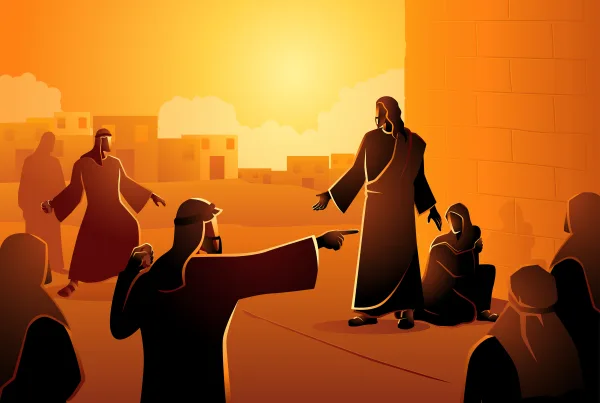


In Matthew 6:19–24, Jesus shifts from the practices of devotion—giving, praying, and fasting—to deeper matters of the heart. His words about treasure, vision, and loyalty remind us that our lives are always shaped by what we value, what we focus on, and whom we serve.
Treasures on Earth and in Heaven
Jesus begins with a contrast: “Do not store up for yourselves treasures on earth, where moth and rust destroy, and where thieves break in and steal. But store up for yourselves treasures in heaven… for where your treasure is, there your heart will be also” (Matthew 6:19–21).
Earthly treasures are fragile. In the first century, wealth was often measured in grain and clothing, both vulnerable to insects, rot, or theft. Even if possessions lasted a lifetime, death would strip them away. Job understood this: “Naked I came from my mother’s womb, and naked I shall return” (Job 1:21).
Jesus does not denounce possessions themselves. Scripture affirms that providing for one’s household is necessary (1 Timothy 5:8), and Paul teaches that God “richly supplies us with all things to enjoy” (1 Timothy 6:17). The danger lies in pride and misplaced trust. Wealth whispers that we are secure, self-sufficient, even superior. Yet riches are uncertain, while God is faithful.
Paul exhorts believers “to be rich in good works, to be generous and ready to share” (1 Timothy 6:18). True treasure is not measured by accumulation but by generosity, gratitude, and stewardship. By investing in God’s kingdom and serving others, we lay hold of riches that endure beyond this life.
Pilgrims and Strangers
Hebrews 11 reminds us that the heroes of faith saw themselves as “strangers and exiles on the earth” (v. 13). They lived for promises they did not yet see, looking forward to “a city with foundations, whose architect and builder is God” (v. 10). Abraham left his homeland because his heart was fixed on that eternal city.
This perspective is essential for us. Scripture begins in a garden but ends in a city—the New Jerusalem. In Adam, paradise was lost. In Christ, it is restored and transformed. We do not return to innocence but move forward to righteousness, clothed in Christ’s righteousness. As pilgrims, we hold earthly goods lightly, knowing they are temporary and entrusted to us only for a season.
The Heart Follows Treasure
Jesus’ words are direct: “For where your treasure is, there your heart will be also” (Matthew 6:21). Whatever we value most shapes our desires, priorities, and actions. To set our hearts on earthly wealth is to tether our lives to what cannot last. To treasure God and His kingdom is to anchor ourselves in what is eternal.
Luke 16:15 warns that what the world esteems is often detestable in God’s sight. Culture celebrates wealth, success, and recognition, but these pursuits often disappoint. Those who achieve them discover they do not satisfy. Accomplishment itself can become an idol, eroding the work of the Spirit in us.
The Lamp of the Body
Jesus deepens His teaching with another metaphor: “The lamp of the body is the eye. If therefore your eye is clear, your whole body will be full of light. But if your eye is bad, your whole body will be full of darkness” (Matthew 6:22–23).
The eye directs the body, guiding every step. Likewise, our spiritual vision directs our lives. A clear eye—a heart fixed on God—fills the whole life with light. A bad eye—one clouded by greed or selfish ambition—fills the whole life with darkness. And if what we think is light is actually darkness, Jesus warns, “how great is that darkness!”
Our focus shapes our destiny. Proverbs 4:25 exhorts, “Let your eyes look directly ahead.” Paul echoes this in Colossians 3:1–2: “Set your mind on the things above, not on the things that are on earth.” Where we fix our gaze reveals what we love most.
Serving Two Masters
Jesus concludes with a decisive statement: “No one can serve two masters… You cannot serve God and mammon” (Matthew 6:24). Mammon represents wealth or material prosperity. His claim is straightforward: divided allegiance is impossible. A slave in the ancient world could not belong to two masters. In the same way, our ultimate loyalty cannot be split.
We may try to convince ourselves otherwise, imagining we can serve God and money, but our devotion always reveals the truth. God will not share His glory. He is jealous for the loyalty of His people (Isaiah 42:8). To serve Him only halfway is to enthrone another master in His place.
The contrast between God and mammon is stark. God is eternal; mammon is temporary. God is the Creator; mammon belongs to creation. God is unseen but ultimate; mammon is visible but fleeting. Both can be worshiped, but only one is worthy. To serve God is to exchange our lives for eternal joy. To serve mammon is to trade them for what cannot last.
The Choice Before Us
Jesus brings the matter to its conclusion. Our treasure shapes our hearts. Our vision shapes our lives. Our master shapes our destiny. The Sermon on the Mount confronts us with these unavoidable questions: What do you value most? Where is your treasure? What is your vision fixed upon? Whom do you serve?
The pull of culture is powerful, urging us to find life in possessions, success, or acclaim. Yet even when attained, these things leave us empty. Only Christ offers treasures that endure. Only His light fills the soul. Only His lordship satisfies the heart.
We cannot serve two masters. To serve God is to surrender all to Him in trust and obedience. To serve mammon is to enthrone a counterfeit god that will fail us in the end. Jesus calls us to fix our eyes on what is unseen and eternal, to treasure Him above all else, and to invest in riches that will never fade.
To explore the Sermon on the Mount more deeply and discover how to thoughtfully answer the questions below, subscribe to Ken Boa Reflections on Substack.
Questions for Reflection
- What do your current pursuits and priorities reveal about where your treasure truly lies—on earth or in heaven?
- How does your vision—what you fix your eyes and hopes upon—shape the overall direction of your life?
- In what subtle ways might wealth or material security be competing with God for your loyalty?
- What would it look like for you, in practical terms, to serve God wholeheartedly rather than trying to divide your devotion between Him and other masters?