
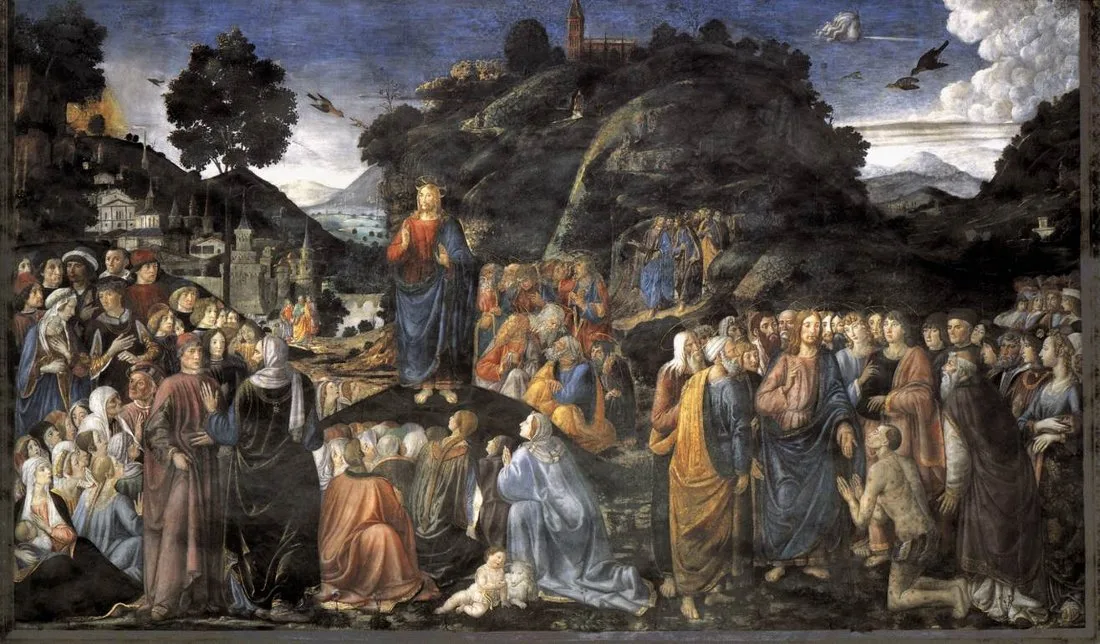
We have come to the final two verses that conclude the Sermon on the Mount. Strictly speaking, these verses are not part of the sermon itself. Rather, they describe the response of those who heard it—both the crowds who were present and the disciples who had been with Jesus from the beginning.
“When Jesus had finished these words, the crowds were amazed at His teaching” (Matthew 7:28). The word Matthew uses could even be translated dumbfounded. They were stunned. And then Matthew explains why: “For He was teaching them as one having authority, and not as their scribes” (Matthew 7:29).
These verses are brief, but they are anything but insignificant. They confront us with a question that does not fade with time: What do we do with a Jesus who speaks like this?
The Sermon Is Framed by Authority
The Sermon on the Mount is carefully bookended. Matthew tells us how it began: “When Jesus saw the crowds, He went up on the mountain; and after He sat down, His disciples came to Him. He opened His mouth and began to teach them” (Matthew 5:1–2). This is formal language. It signals that something momentous is about to be declared. A teacher sits. A crowd gathers. A message is delivered.
The ending mirrors the beginning. Jesus finishes speaking, and the people are astonished. Matthew wants us to feel the weight of it. These were not ordinary words spoken by an ordinary man.
It is difficult for us to place ourselves fully in that moment, because we hear these words after centuries of repetition. Familiarity can dull astonishment. But if we heard this sermon for the first time—if we encountered these claims without prior categories—I believe we would be stunned as well. Jesus speaks with a confidence, clarity, and decisiveness unlike anything else.
You Cannot Separate Jesus from His Teaching
Many people attempt to distinguish between a “simple Jesus”—a humble moral teacher—and the fuller portrait of Jesus in the rest of the New Testament. But that distinction simply does not hold. You cannot separate Jesus from His teaching, because His teaching is inseparable from who He claims to be.
This sermon is not simple in the sense of being shallow. It is profound, demanding, and decisive. Jesus speaks as though He holds the words of life and death. He tells us which way leads to life and which way leads to destruction. He tells us that our response to His words is bound up with our ultimate destiny.
Near the end of the sermon, He says, “Many will say to Me on that day… and then I will declare to them, ‘I never knew you’” (Matthew 7:22–23). That statement alone makes it impossible to treat this sermon as mere moral advice. The issue is not simply what people believed, but how they stood in relation to Him.
This is why it makes no sense to say, “I love the Jesus of the Sermon on the Mount, but not the Jesus of doctrine.” Doctrine simply means teaching. Everyone has doctrine. The question is whether it is true. Even those who claim to have none reveal their beliefs by the way they define Jesus.
Revelation does not allow us to remain passive. When God speaks, a response is required.
Revelation Requires Response
Throughout Scripture, God’s revelation is never given merely for information. It is given for transformation. God has revealed Himself in creation, and that revelation requires a response (Romans 1). He has revealed Himself in conscience, and that too requires a response (Romans 2). But in Scripture—special revelation—God speaks most directly. He not only reveals who He is; He calls us to choose how we will respond to Him.
James tells us that the Word is like a mirror (James 1:23–25). We can look into it, see ourselves, and walk away unchanged. Or we can look, receive what we see, and respond. The Word reveals us to ourselves. It exposes our motives, our fears, our rationalizations. And it presses us toward obedience.
That is why the reaction of the crowds matters. They are not merely impressed. They are confronted.
A Unique Teaching: The Way of the Kingdom
The first thing we see is that Jesus offers a unique teaching. He reveals a way of life that is radically different from both irreligious culture and religious formalism.
In the Sermon on the Mount, Jesus describes a different righteousness, a different love, a different approach to forgiveness, a different ambition, and a different Master. This is not a call to minor moral improvement. It is a call to an entirely new orientation of life.
And this teaching is not only exhortative; it is deeply pastoral. Jesus speaks to worry, fear, and anxiety. He invites us to trust the sovereignty of God—not only over history and creation, but over the details of our lives. He assures us that we need not be consumed by fear, because worry is not only unproductive; it fails to account for the authority and care of the living God.
One of the great distinctives of the biblical vision is that God is able to transmute suffering into good. He does not always remove pain, but He transforms it. He weaves even adversity into His redemptive purposes. “All things work together for good to those who love God” (Romans 8:28)—not in isolation, but together, in ways we often cannot see.
Many of God’s purposes will not be fully clear to us in this life. The book of Job reminds us that Scripture is less concerned with explaining suffering than with revealing God’s sovereignty. The only way to live with unresolved pain is to embed our broken stories within a larger story—one that ends in redemption.
And Scripture assures us that nothing can separate us from the love of God in Christ Jesus our Lord (Romans 8:38–39). We are held by the grip of grace.
A Unique Authority: Not as the Scribes
The second thing we see is that Jesus teaches with unique authority. Matthew tells us that He taught “not as their scribes.” The scribes taught by appealing to other authorities—earlier rabbis, established traditions, accumulated interpretations. They spoke by authority.
Jesus speaks with authority.
There is no uncertainty in His voice. No hedging. No appeal to precedent. He speaks as though He knows reality from the inside. This is why the crowds are stunned.
Even the Old Testament prophets spoke differently. They said, “Thus says the Lord.” Jesus repeatedly says, “But I say to you.” He does not merely deliver God’s word; He speaks with God’s authority. That is an extraordinary claim.
And it forces a conclusion: either Jesus is profoundly mistaken, or He is who He claims to be.
Jesus the Teacher and the Messiah
Jesus’ authority is not only that of a supreme Teacher. It is the authority of the Messiah.
He says, “I did not come to abolish the Law or the Prophets, but to fulfill them” (Matthew 5:17). To fulfill them is to be the One to whom they point. After His resurrection, He explains to His disciples how the Scriptures—from Moses and the prophets onward—speak of Him (Luke 24:27).
When Jesus announces that the kingdom of God is at hand, He is declaring that the King has arrived. The message and the Messenger are one. You cannot accept His teaching while rejecting His identity.
This is why it is impossible to separate the “Jesus of history” from the “Christ of faith.” The Gospels do not allow that division. Jesus understood Himself to be on a divine mission, fulfilling the Scriptures and calling people to respond to Him.
Amazed—but Not Neutral
Matthew tells us the crowds were amazed. But amazement is not the same as obedience. It is possible to be astonished by Jesus and still resist His lordship.
The Sermon on the Mount ends with a contrast between two builders. Both hear His words. Only one acts on them. The difference is not exposure to truth, but response to truth.
Storms come to both lives. The difference is the foundation.
Jesus calls us not merely to admire His authority, but to submit to it. Not merely to hear His words, but to build upon them.
The final question remains, just as urgent now as it was then:
Who is this Man—and what will we do with His words?
Amazement is understandable. But wisdom is found in obedience.
To explore the Sermon on the Mount more deeply and discover how to thoughtfully answer the questions below, subscribe to Ken Boa Reflections on Substack.
Questions for Reflection
- What is my response to Jesus’ authority—am I merely amazed by His teaching, or am I submitted to it? Where is that difference most visible in my daily life?
- Where am I tempted to separate Jesus from His words—admiring the “Sermon on the Mount Jesus” while resisting the claims He makes about Himself? What do my reactions reveal about who I believe He is?
- When I read or hear Scripture, do I treat it as information, or as a mirror that calls for change? What is one specific truth I already know that God is asking me to apply?
- On what foundation am I building right now—Christ’s words obeyed, or Christ’s words merely heard? What “next act of obedience” would move me from hearing to doing this week?